Voice Acting: A Beginner's Guide to Getting Started
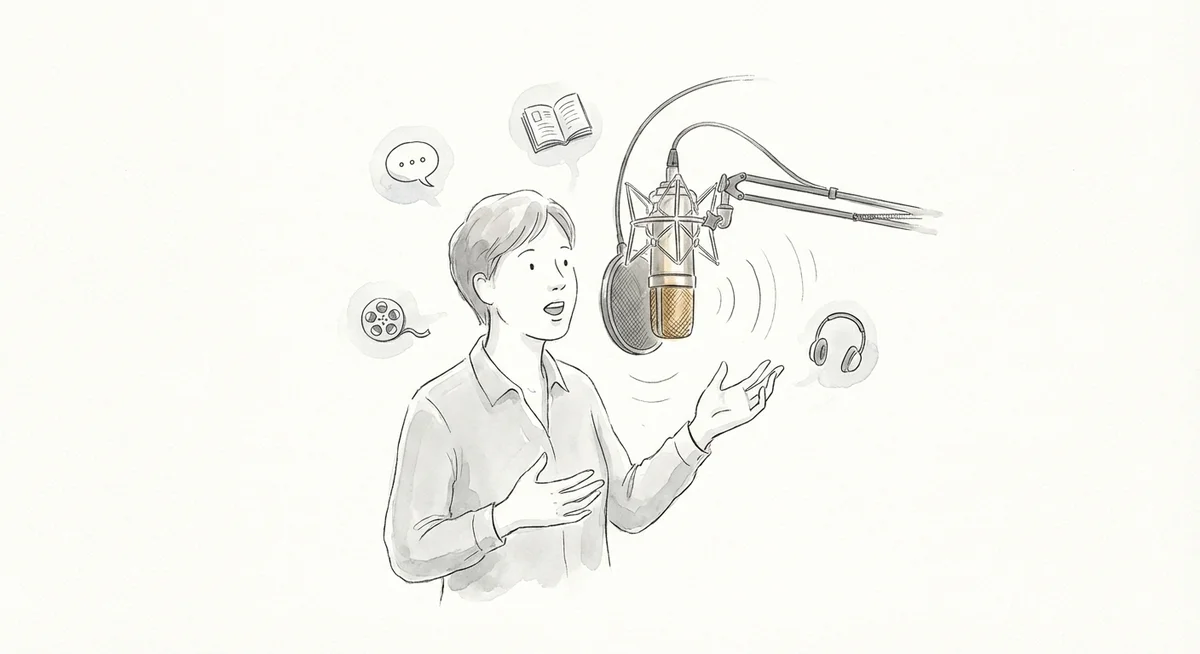
Voice acting is acting. That sounds obvious, but it's worth saying up front. You're not reading a script into a microphone. You're making choices, creating characters, shaping tone and rhythm, moving listeners with nothing but sound. It takes everything you know about acting and pairs it with a distinct set of technical skills.
If you're an actor curious about voice work, or a newcomer who loves telling stories aloud, this guide will give you practical next steps for building a voice career in the UK. We'll be honest about what's involved, because voice acting deserves to be taken seriously.
What voice acting actually involves
Most people assume voice work is "reading aloud with a nice voice." It demands far more. You're working with objectives and beats, just as you would on stage or screen. You need breath control to sustain long sessions, the ability to sight-read confidently, to create characters quickly, and to take direction without getting defensive.
A useful way to think about it: acting in a box. Every emotional shift, every relationship, every moment of tension or warmth has to come through your voice alone. No facial expression to lean on, no gesture to fill a gap. That constraint is what makes voice acting both difficult and satisfying.
Sessions can be intense, too. You might record for several hours at a stretch, switching between characters or delivering dozens of takes of the same line. Stamina and adaptability are non-negotiable.
Types of voice work
Voice acting isn't one job. Each area has its own demands, and most working voice actors specialise in a few rather than trying to cover everything.
Animation and cartoons require strong character work and vocal versatility. You'll often voice multiple characters in a single session, switching rapidly between them.
Audiobooks and narration demand pacing and the ability to sustain a story over many hours of recording. The UK audiobook market is growing fast, with income for UK publishers hitting a record £268 million in 2024.
Commercials are about tone, branding, and tight timings. You might have 20 or 30 seconds to land a message convincingly.
Video games involve character acting across non-linear scripts and sometimes vocally intense scenes (combat, distress, exertion). Sessions can be physically demanding.
Corporate narration and e-learning require clear, trustworthy delivery and the knack for making dry copy sound natural.
Dubbing and ADR need precision timing to match lip-sync and picture. Working to strict visual cues is a skill in itself.
If you're starting out, listen widely. Pay attention to the voiceover on adverts, the narration on documentaries, the characters in animated series. Notice what each type of work asks of the performer.
Essential skills to develop
Beyond a pleasant-sounding voice (which, honestly, is the least of it), voice acting requires skills you can actively train.
Vocal range and control means more than accents and impressions. It's the ability to shift tone, pace, pitch, and energy with intention.
Character creation is about building distinct voices through vowel and consonant shifts, rhythm, placement, and attitude, often at short notice.
Cold reading matters constantly. You need to pick up a script you've never seen and deliver a credible, connected performance almost immediately.
Taking direction in voice sessions is fast. Directors give adjustments quickly and expect you to respond without overthinking. Flexibility matters more than perfection.
Microphone technique means understanding proximity, plosives, mouth noise, and how to move expressively without creating unwanted sounds.
Emotional authenticity without visuals is perhaps the biggest challenge. You need to carry genuine emotion and subtext through sound alone.
None of these arrive fully formed. Everyone builds them over time.
How traditional acting training helps
If you already have stage or screen experience, you're not starting from zero. Objectives, beats, text analysis, listening, emotional truth: these transfer directly into voice work. You already understand what it means to play an action through a scene, and that understanding is invaluable behind a microphone.
What's different is the absence of physicality. On stage, your body tells half the story. In a voice booth, the microphone picks up everything (every breath, every rustle of clothing, every tiny click of the mouth) but it can't see your face. All of that physical expressiveness has to become vocal.
If you've trained primarily for stage, you may also need to scale down. Microphone work rewards subtlety and intimacy. A whisper can hit harder than a shout when the mic is six inches from your mouth.
Getting started with training
You don't need to spend a fortune, but structured training will save you time and help you avoid habits that are hard to undo later.
Voice acting coaches. Look for coaches with current, professional voice acting experience, not just general voice or speech training. A good coach will work on technique, interpretation, and microphone skills together. Our directory can help you find specialists.
Workshops. Many UK studios and casting organisations run introductory voice acting workshops. These are great for hands-on booth experience and for meeting other people in the field.
Online courses. A practical option if you're not near a major city. Look for courses that include feedback on your recordings rather than passive video lessons alone.
Recommended reading. The Art of Voice Acting by James Alburger is thorough and well-regarded. There's Money Where Your Mouth Is by Elaine A. Clark is strong on the commercial side. Both are US-focused in places, but the core principles apply.
Record yourself regularly, even informally. Read articles, stories, and scripts aloud, then listen back critically. You'll learn a surprising amount just by hearing yourself with fresh ears.
Setting up a home studio on a budget
Many clients now expect voice actors to record remotely, so a basic home setup is becoming essential. You don't need to spend thousands.
What you need to begin:
A reliable condenser microphone. The RØDE NT1 is popular for its low self-noise and clean sound. The Audio-Technica AT2020 is a solid, more affordable alternative.
An audio interface. The Focusrite Scarlett 2i2 is an industry standard at entry level, connecting your mic to your computer with good preamps.
Closed-back headphones for monitoring without sound leaking back into the mic. The Audio-Technica ATH-M50x are well-regarded and reasonably priced.
A quiet, treated space. This matters more than your microphone. Heavy blankets, duvets, or foam panels will reduce room reflections cheaply. A wardrobe full of clothes can work surprisingly well as a temporary booth.
Recording software. Audacity is free and perfectly capable for beginners. Later you might move to Reaper (very affordable) or Adobe Audition.
A pop filter, boom arm, shock mount, dedicated acoustic panels, and higher-end software are all worthwhile upgrades, but none are essential on day one. Start with the basics, learn to use them well, and invest as your work demands it.
Creating a demo reel
Your demo reel is what agents and clients will use to decide whether to audition or hire you, so it needs to represent your best work honestly.
Keep it short. A commercial reel should be around 60 to 90 seconds. Narration and character reels can run slightly longer, but rarely more than two minutes.
Lead with your strongest clip. Listeners often decide within the first few seconds.
Create separate reels for different niches. A single reel trying to cover commercials, animation, and audiobooks will sound unfocused. Tailor each reel to the type of work you're pursuing.
Avoid common mistakes. Don't include material polished beyond your actual ability. Don't mimic existing adverts or famous characters. Don't pad with weaker material just to add length.
If you're starting out, working with a professional demo producer who understands the industry is usually worth the cost. They'll help you choose appropriate material, direct your performance, and ensure the audio quality meets professional standards. A poorly produced demo can do more harm than having no demo at all.
Finding work in the UK
Building a voice acting career takes time, and the work comes through several channels.
Voice agents. Once you have a professional demo, approach reputable UK agencies like Calypso Voices, Hobsons, or Yakety Yak. Research carefully and only approach agencies that don't charge upfront fees.
Casting platforms. Sites like Backstage and Mandy regularly list voice acting roles in the UK and can be a good source of early credits.
Direct outreach. Contact local production companies, animation studios, e-learning developers, and advertising agencies. A short, professional email with a link to your reel can open doors.
Equity membership. Joining Equity, the UK performers' union, is worth doing. They offer guidance on contracts, rates, and working conditions for audio work, which is especially valuable when you're new and unsure what's fair.
Reputation. Word of mouth matters enormously in voice work. Be reliable, be easy to work with, deliver clean audio on time. Repeat bookings and referrals will become your most valuable source of income.
Common misconceptions worth addressing
A few things worth being straightforward about.
"Anyone with a good voice can do it." A pleasant voice is a starting point, not a career. Clients pay for your ability to act, interpret a script, take direction, and deliver consistent professional recordings. The skill is in the acting and technique, not the timbre.
"It's easy money." Voice acting can pay well at the higher levels, but most newcomers earn modestly while they build skills and client base. Think of the first year or two as an investment period. Earnings grow as you gain experience and refine your niche.
"The market is saturated." The market is competitive, yes. But audiobooks, podcasts, e-learning, and gaming are all growing sectors. What matters is whether you're willing to do the work to become genuinely good and to market yourself consistently.
"You need an expensive studio." As covered above, a solid basic setup is more affordable than you might think. What you need most is a quiet room and the willingness to learn your equipment.
Voice acting is open to newcomers who approach it with respect for the craft, a willingness to train, and realistic expectations. If that sounds like you, there's no reason not to start today, even if starting just means reading a script aloud, recording it on your phone, and listening back honestly.